Introduction
Young children often learn complicated ideas most naturally when they can touch, move, build, take apart, and experiment with physical objects. Concepts such as cause and effect, rotation, positioning, and mechanical movement can be difficult to explain with words alone, but a hands-on construction activity can turn those ideas into something children can observe directly.
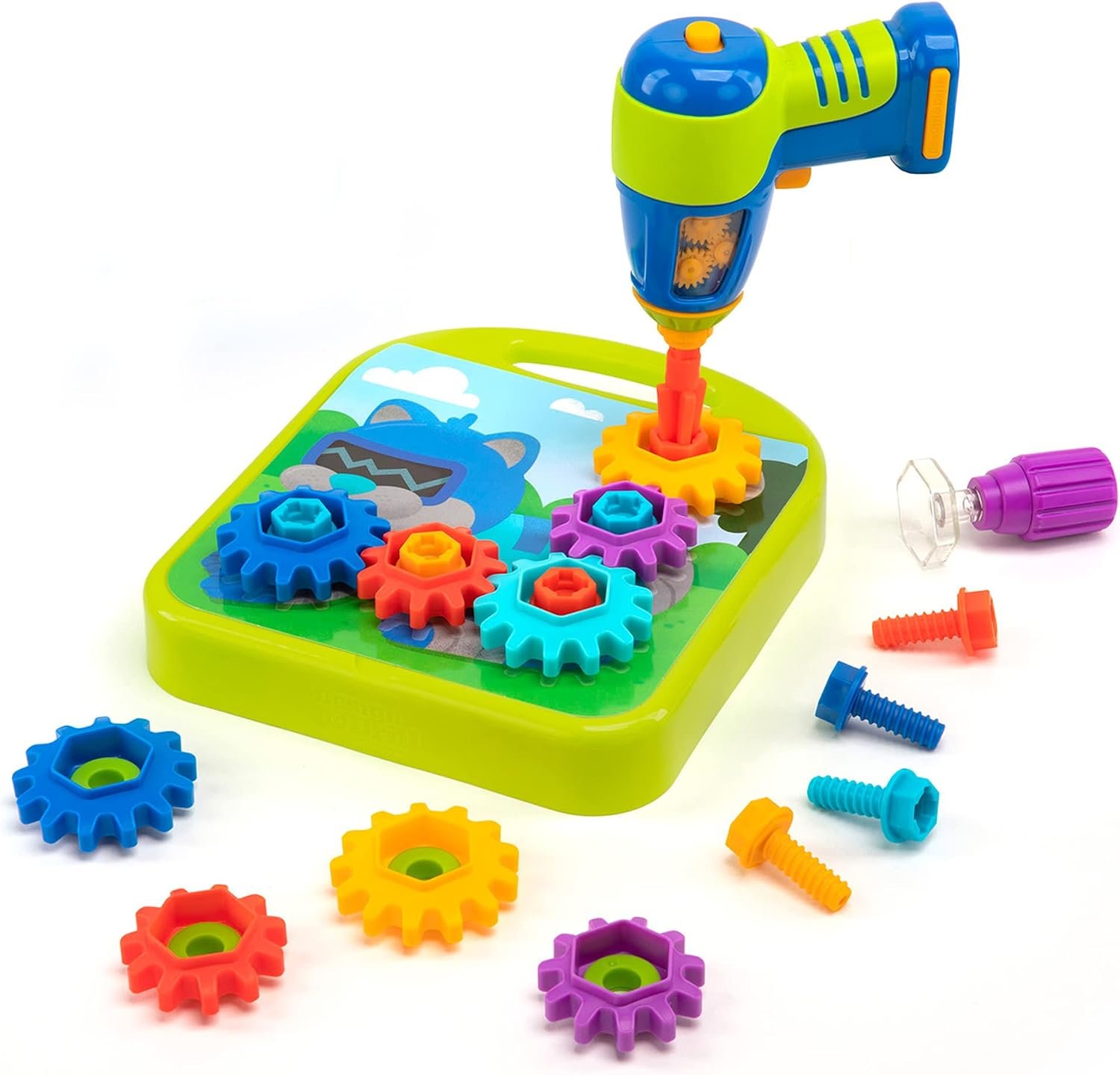
The Educational Insights Design & Drill Gears Workshop is a preschool-oriented construction and STEM activity centered around gears, bolts, a drilling board, and child-friendly tools. Designed for children ages 3 and up, the set lets children follow visual patterns or create their own arrangements while exploring how interlocking gears transfer movement. Educational Insights describes the activity as an introduction to basic engineering, construction, and cause-and-effect concepts.
The concept is relatively straightforward. Children place bolts and gears onto a perforated activity board, use a toy drill or manual screwdriver to secure components, and then turn the gears to see how movement can travel from one gear to another. The activity therefore combines construction with experimentation.
According to Educational Insights, the set includes a kid-friendly electric drill, hand crank, screwdriver, 10 gears in two sizes, 32 bolts, a drilling board, and 10 double-sided pattern cards. The drill requires two AA batteries, which are not included. The manufacturer lists the set as containing 55 pieces and measures the packaged product at approximately 8.6 by 9.1 by 3.7 inches.
The Gears Workshop can be approached in several ways. A child can begin by following one of the included pattern cards, practice placing bolts and gears in the correct locations, and then move toward creating original arrangements. This gradual transition from guided construction to open-ended experimentation makes the activity suitable for introducing mechanical ideas without requiring children to understand technical engineering terminology.
This article explores the Design & Drill Gears Workshop in detail, including its components, learning concepts, practical activity ideas, age considerations, safety points, comparisons with other categories of construction toys, and ways caregivers can turn the set into a broader STEM learning experience.
Key Features of the Design & Drill Gears Workshop
A Hands-On Gear Construction Activity
The central idea behind the Gears Workshop is the creation of simple gear systems.
Children are not simply looking at a finished model. They physically place components, secure them, turn them, and observe the result.
This creates several opportunities for active learning:
- Identifying individual components
- Matching pieces to visual patterns
- Positioning gears correctly
- Tightening bolts
- Operating a child-friendly drill
- Turning gears manually
- Observing movement
- Changing an arrangement
- Testing what happens
- Creating original designs
Educational Insights positions the set as a construction toy that introduces basic engineering and cause-and-effect principles through play.
Kid-Friendly Electric Drill
One of the most distinctive parts of the set is the electric toy drill.
The drill allows children to tighten bolts onto the activity board rather than relying exclusively on a manual screwdriver. Educational Insights describes the tool as a kid-friendly drill designed for the Design & Drill system.
Using a tool introduces a different type of interaction from simply snapping construction pieces together.
The child needs to:
- Hold the drill.
- Position it correctly.
- Align it with the bolt.
- Activate the drill.
- Observe the bolt moving into position.
- Stop when the component is secured.
That sequence requires coordination between visual information and hand movement.
The drill is therefore not merely decorative. It is part of the construction activity itself.
Manual Screwdriver
The set also includes a screwdriver.
This provides an alternative to the electric drill and allows children to explore the same construction task using a manual tool.
The difference between the two tools can become an interesting learning opportunity.
A caregiver can ask:
“Which one moves by itself?”
“Which one do you have to turn?”
“Do they both tighten the bolt?”
These questions encourage children to notice differences in mechanical operation.
The manual screwdriver can also be useful when the goal is slower, more deliberate construction.
Hand Crank
The hand crank provides another way to interact with the gears.
Instead of relying on the electric drill for movement, children can manually turn the system and observe how one gear affects another.
This is particularly useful when introducing cause and effect.
A child can turn one gear slowly and watch another gear rotate. Then the child can change the arrangement and see whether the result changes.
The hand crank therefore turns the gear system into a simple mechanical experiment.
Gears in Two Sizes
Educational Insights lists 10 gears in two sizes as part of the set.
Having different gear sizes provides opportunities to compare components.
Children can explore questions such as:
- Which gear is larger?
- Which gear is smaller?
- How many teeth does each gear have?
- Can two gears fit together?
- What happens when gears of different sizes interact?
- Which direction does the second gear turn?
These observations introduce early mechanical concepts without requiring formal mathematical calculations.
32 Colorful Bolts
The set includes 32 bolts that secure the components to the activity board.
The bolts serve both a functional and developmental purpose.
Functionally, they hold the gears and other components in position.
From a learning perspective, picking up, positioning, and tightening the bolts requires controlled hand movements.
The different colors can also be incorporated into activities involving color recognition, sorting, pattern creation, and counting.
For example, a caregiver might ask a child to find all the blue bolts or create a pattern using two colors.
Drilling Board
The drilling board provides the structured surface where the child builds the designs.
Its perforated layout gives children predetermined locations for placing bolts and gears.
This structure is important because it makes the construction process manageable for young children. Instead of having to invent a mechanical system entirely from scratch, they can begin with a board that already provides possible attachment points.
The board also allows designs to be dismantled and rebuilt.
Ten Double-Sided Pattern Cards
The set includes 10 double-sided pattern cards, providing multiple visual designs to recreate. Educational Insights identifies the cards as part of the 55-piece set.
Pattern cards can be useful for introducing the activity because they provide a clear objective.
Instead of asking a young child to design a gear system without guidance, a caregiver can begin with:
“Let’s make this picture.”
The child then studies the card, identifies the required components, and works toward reproducing the arrangement.
Once the child becomes familiar with the process, the cards can serve as inspiration rather than strict instructions.
Understanding the Learning Concepts
Cause and Effect
One of the clearest concepts demonstrated by the Gears Workshop is cause and effect.
A child turns one gear, and another gear moves.
That relationship is immediately visible.
For a young learner, this can be more meaningful than simply hearing an explanation of mechanical transfer.
The caregiver can make the observation explicit:
“When you turn this gear, what happens to that one?”
Then the child can experiment with different arrangements.
Early Engineering Concepts
The set provides an introductory way to explore basic mechanical relationships.
Children can discover that components need to be positioned correctly for a system to work.
If two gears are too far apart, they may not interact.
If they are positioned correctly, movement can transfer from one to another.
This is an early version of engineering thinking: identify a goal, construct something, test it, observe the result, and make adjustments.
Fine Motor Development
Fine motor skills involve controlled movements of the hands and fingers.
The Gears Workshop requires children to manipulate relatively small components, position bolts, hold tools, and rotate mechanisms.
Educational Insights specifically identifies fine motor development as one of the skills supported by the Design & Drill line.
These activities involve movements that are different from simply holding a large toy.
The child has to coordinate fingers and hands with visual information from the board.
Hand-Eye Coordination
Hand-eye coordination is relevant throughout the construction process.
A child needs to look at the location of a hole and place a bolt accurately. The child then needs to position the drill or screwdriver over the bolt.
Similarly, gears need to be positioned where they can interact.
The activity therefore combines visual planning with physical execution.
Problem-Solving
Not every arrangement will work immediately.
That is part of the learning process.
A child may place a gear incorrectly and discover that it does not turn. Instead of simply correcting the mistake for them, a caregiver can ask:
“What do you think we should change?”
The child can then move the gear, test the new position, and observe the difference.
This creates a basic problem-solving loop:
Try → Observe → Adjust → Try again.
Spatial Reasoning
The activity also involves understanding where objects fit relative to one another.
Children need to consider position, direction, distance, and orientation.
A gear that works in one location may not work in another.
These observations can help introduce spatial vocabulary such as:
- Next to
- Between
- Above
- Below
- Close
- Far
- Inside
- Outside
- Left
- Right
How the Design & Drill Gears Workshop Can Be Used
Starting With Pattern Cards
For a first activity, choose one of the included pattern cards.
Place it where the child can clearly see it and identify the required pieces.
Rather than completing the entire design for the child, divide it into smaller steps.
For example:
- Identify the first group of bolts.
- Place them on the board.
- Secure them.
- Add the first gear.
- Add the next gear.
- Check whether the gears connect.
- Test the finished arrangement.
This approach makes a complex-looking design easier to understand.
Creating a Simple Gear Chain
After children become familiar with the pieces, encourage them to create a basic chain of interlocking gears.
Start with two gears.
Ask the child to turn one.
Then introduce a third.
Ask:
“What happens now?”
Adding one gear at a time helps children see how each new component changes the system.
Exploring Direction
Gears provide an opportunity to discuss direction.
When one gear turns clockwise, the adjacent gear generally turns in the opposite direction.
Young children do not need to memorize those technical terms immediately.
A simpler activity is:
“Turn this one to the right. Which way does the next one turn?”
Then reverse the movement.
This can turn mechanical play into an early lesson in observation.
Comparing Gear Sizes
Use the two gear sizes to introduce comparison.
Place a larger gear beside a smaller gear and ask:
“Which one is bigger?”
Then connect them and turn one.
The caregiver can encourage the child to notice whether the gears appear to rotate at different rates.
The goal at this age does not need to be a formal lesson about gear ratios. Observation is enough.
Creating Color Patterns
The bolts and gears provide opportunities for simple color activities.
A child could create:
- Red-blue-red-blue patterns
- Groups of one color
- Rainbow arrangements
- Symmetrical color designs
This adds an early mathematics component to the construction activity.
Counting Bolts and Gears
Counting can also be integrated naturally.
Instead of asking a child to count objects from a worksheet, ask them to count the pieces they need.
For example:
“How many bolts do we need?”
“How many gears are on the board?”
“How many blue bolts did you use?”
This makes counting part of a practical activity.
Designing Without a Pattern
Open-ended construction can be introduced once the child understands the basic system.
Instead of providing a target design, say:
“Can you make your own gear machine?”
There does not need to be one correct answer.
The child can experiment with different arrangements and see which ones create movement.
This type of activity can encourage creativity while retaining the mechanical focus of the toy.
Who the Design & Drill Gears Workshop May Be Suitable For
Preschool Children
Educational Insights recommends the Gears Workshop for ages 3 and up.
Its large construction components, visual cards, and simplified tools are designed around preschool-level interaction.
Children within the recommended age range may approach the activity differently depending on their previous experience with construction toys.
Children Interested in Building
Children who naturally enjoy assembling objects, taking things apart, and experimenting with moving parts may find this type of activity particularly relevant.
The gear mechanism gives construction an immediate purpose: the pieces are not only being arranged; they are being used to create movement.
Early STEM Learning
The product fits naturally into early STEM activities.
It can be used to introduce:
- Mechanical movement
- Cause and effect
- Simple machines
- Engineering design
- Observation
- Problem-solving
- Spatial relationships
These concepts can be explored informally through play.
Homeschool and Home Learning
Parents who incorporate hands-on activities into home learning can use the set as a physical STEM station.
A short session could involve one pattern card followed by an open-ended design challenge.
The activity can therefore be incorporated without turning play into a formal classroom lesson.
Preschool Classrooms
The Gears Workshop can also fit into supervised classroom activity stations.
The components can be used for small-group construction, rotating stations, or teacher-guided demonstrations.
Because the set contains small parts, classroom use should include appropriate supervision and storage procedures.
Important Things to Consider
The Product Contains Small Parts
Educational Insights explicitly identifies the Gears Workshop as a choking hazard because it contains small parts and states that it is not intended for children under 3 years.
This is an important consideration for households with younger siblings.
The components should be stored where children under the recommended age cannot access them, particularly when the set is not being used.
Pets should also be prevented from accessing small components.
Adult Supervision Is Appropriate
Although the set is designed for children, supervision can be valuable, especially during initial use.
Adults can help children understand how the tools work, keep pieces organized, and ensure that components are being used appropriately.
Supervision is particularly relevant around younger siblings and shared play spaces.
Batteries Are Not Included
The electric drill requires two AA batteries, and Educational Insights states that batteries are not included.
Families should therefore check the battery compartment and manufacturer instructions before use.
Battery installation and replacement should be handled appropriately by an adult, particularly when the toy is being used by young children.
The Drill Is a Toy Tool
The electric drill is designed as a children’s toy and should be used only with the components intended for the Design & Drill system.
It should not be used as an actual household power tool or applied to real construction materials.
Children should understand that the toy drill is part of the play system rather than a substitute for an adult’s tools.
Components Can Be Misplaced
The set contains numerous individual bolts, gears, cards, and tools.
Small pieces can easily become separated from the main set.
A storage routine can help.
For example, all components can be returned to the original container or a dedicated storage box after play.
Keeping pieces organized also makes the next activity easier to begin.
Pattern Cards and Free Play Serve Different Purposes
Pattern cards provide structure, while free play provides more creative freedom.
A child who struggles with open-ended construction may benefit from beginning with the cards.
A child who already understands the basic mechanics may prefer to design independently.
There is no need to use the cards in every session.
Comparison With General Construction Toy Categories
Gear Construction Set vs. Traditional Building Blocks
Traditional building blocks emphasize stacking, balancing, shape, and structural construction.
The Gears Workshop introduces an additional mechanical element.
Instead of simply constructing a stationary object, children can create systems where one component affects another.
Both categories can support spatial reasoning, but the type of problem-solving involved can be different.
Gear Construction Set vs. Standard Construction Kits
Many construction kits rely on connectors, pegs, screws, or interlocking pieces.
The Gears Workshop places particular emphasis on rotational movement.
This gives children an opportunity to explore how components interact dynamically.
The addition of the drill also gives the construction process a tool-based component.
Gear Workshop vs. Pretend-Play Tool Sets
Pretend tool sets often focus on role-playing activities such as pretending to repair a vehicle, build a house, or work in a workshop.
The Gears Workshop includes some elements of that experience but connects them to a functional construction system.
The child actually uses the toy drill to secure bolts and then observes the mechanical result of the completed arrangement.
Gear Workshop vs. Electronic STEM Toys
Electronic STEM toys can introduce programming, robotics, lights, sounds, or digital problem-solving.
The Gears Workshop takes a more physical approach.
There is no need for a screen or programming interface to observe the mechanical relationship between the gears.
This makes the activity particularly focused on tangible construction and physical cause and effect.
Gear Workshop vs. Simple Puzzle Activities
Puzzles generally involve matching pieces to form a predetermined result.
Pattern cards in the Gears Workshop share some of that visual-matching element, but the completed arrangement can also move.
Children therefore work with both visual information and mechanical function.
Ideas for Caregivers to Extend the Activity
Ask “What If?” Questions
Open-ended questions can turn construction into experimentation.
Try questions such as:
“What happens if we add another gear?”
“What happens if we remove this one?”
“Can you make all the gears move?”
“Which gear should we turn?”
“What happens when the gears are too far apart?”
These questions encourage children to test ideas instead of simply following instructions.
Introduce Basic Engineering Vocabulary
Children can gradually become familiar with words such as:
- Gear
- Bolt
- Rotate
- Turn
- Move
- Connect
- Build
- Design
- Test
- Change
- Fix
- Fast
- Slow
Using the words during play helps connect language with physical actions.
Create Small Challenges
Instead of asking children to build something completely from scratch, give them manageable challenges.
For example:
“Can you make three gears move?”
“Can you use both gear sizes?”
“Can you make a red and blue pattern?”
“Can you build a design with five bolts?”
Each challenge focuses attention on a specific concept.
Encourage Prediction Before Testing
Prediction is an important part of scientific thinking.
Before turning the gear system, ask:
“Which way do you think this gear will turn?”
Then let the child test the prediction.
The result does not need to be correct for the activity to be useful. The comparison between prediction and observation is the learning opportunity.
Cleaning, Storage, and Maintenance
Because the set contains numerous components, keeping the pieces organized is an important part of maintaining it.
After each activity, caregivers can encourage children to:
- Remove the gears.
- Remove the bolts.
- Return the screwdriver.
- Store the drill safely.
- Collect the pattern cards.
- Check the play area for missing pieces.
The electronic drill should be kept away from liquids and should not be treated like a washable plastic construction component.
Battery condition should also be monitored.
If the toy is not going to be used for an extended period, adults may want to follow the manufacturer’s battery-storage recommendations.
The activity cards should be stored flat or in a way that reduces unnecessary bending.
Frequently Asked Questions
What age is the Design & Drill Gears Workshop designed for?
Educational Insights lists the Gears Workshop for children ages 3 and up.
What is included in the set?
The set includes a kid-friendly electric drill, hand crank, screwdriver, 10 gears in two sizes, 32 bolts, a drilling board, and 10 double-sided pattern cards. Educational Insights lists the set as containing 55 pieces.
Does the electric drill require batteries?
Yes. The electric drill requires two AA batteries, and the batteries are not included.
What does the child do with the gears?
Children place the gears onto the activity board, secure components with bolts, and then turn the gears to observe how interconnected pieces move.
Does the set teach engineering?
Educational Insights describes the Gears Workshop as an introduction to basic engineering, construction, and cause-and-effect concepts.
It should be viewed as an early, play-based introduction rather than a formal engineering curriculum.
Can children create their own designs?
Yes. The set can be used with the included pattern cards or for open-ended designs. Educational Insights specifically describes the ability to create custom designs.
Are the gears different sizes?
Yes. The set includes 10 gears in two sizes.
What are the bolts used for?
The bolts secure components to the drilling board and form part of the construction process. They can also be incorporated into activities involving counting, color recognition, and pattern creation.
Is the electric drill a real power tool?
No. It is a child-oriented toy drill designed for use with the Design & Drill system. It should not be used as an actual power tool or for household construction.
Can the manual screwdriver be used instead of the electric drill?
The set includes a screwdriver, giving children a manual alternative for working with the bolts. This can be useful when practicing tool manipulation without using the battery-powered function.
What is the purpose of the hand crank?
The hand crank allows children to interact with the gear mechanism manually and observe how movement travels through connected gears.
Does the set contain small parts?
Yes. Educational Insights explicitly warns that the product contains small parts and identifies it as a choking hazard for children under 3 years.
Is adult supervision recommended?
Young children should be appropriately supervised, particularly because of the small components and the use of an electronic toy tool.
How many pattern cards are included?
The set includes 10 double-sided pattern cards.
What are the dimensions of the product?
Educational Insights lists the product dimensions at approximately 8.6 inches long, 9.1 inches wide, and 3.7 inches high.
Can the Gears Workshop be used without the pattern cards?
Yes. The cards provide visual guidance, but children can also create their own gear arrangements and designs.
Does the toy require a screen or app?
The manufacturer’s listed set consists of physical components, tools, gears, bolts, a board, and activity cards. The learning activity is therefore centered on hands-on construction rather than a screen-based interface.
What skills can children practice with this activity?
Educational Insights identifies early STEM learning, fine motor development, problem-solving, creativity, and spatial reasoning as areas supported by the Design & Drill Gears Workshop and its broader Design & Drill line.
How can parents make the activity more educational?
Parents can ask prediction questions, introduce simple mechanical vocabulary, encourage children to explain their designs, and connect the gear activity to real-world examples such as bicycles, clocks, machines, or other systems that use rotating components.
Conclusion
The Educational Insights Design & Drill Gears Workshop provides a physical approach to early STEM learning by combining construction, toy tools, gears, bolts, pattern cards, and mechanical movement. Designed for children ages 3 and up, it gives young builders a way to explore concepts such as cause and effect, rotation, positioning, problem-solving, and fine motor coordination through hands-on activity.
The combination of an electric toy drill, manual screwdriver, hand crank, gears in two sizes, and 32 bolts gives the activity several layers. Children can begin by following one of the included double-sided pattern cards and gradually move toward creating their own arrangements.
One particularly useful aspect of gear-based construction is that children can immediately observe whether their arrangement works. If two gears connect correctly, movement transfers between them. If they are positioned incorrectly, the system may not behave as expected. That creates a natural opportunity to experiment, make predictions, identify problems, and try again.
The activity can also be extended beyond mechanical concepts. The colorful bolts and gears can support counting, color recognition, pattern creation, and vocabulary development. Caregivers can turn individual building sessions into broader conversations about movement, machines, design, and everyday objects.
At the same time, the recommended age and safety information should be taken seriously. The set contains small parts and is not intended for children under 3 years. The electronic drill requires two AA batteries, which are not included, and the toy should be used as a children’s construction tool rather than as a substitute for a real power tool.
For families, educators, and caregivers looking for a hands-on construction activity centered on gears and basic mechanical ideas, the Gears Workshop offers a structured starting point while leaving room for open-ended experimentation.
You can check more details on Amazon here.
As an Amazon Associate, we earn from qualifying purchases.
Leave a Reply